


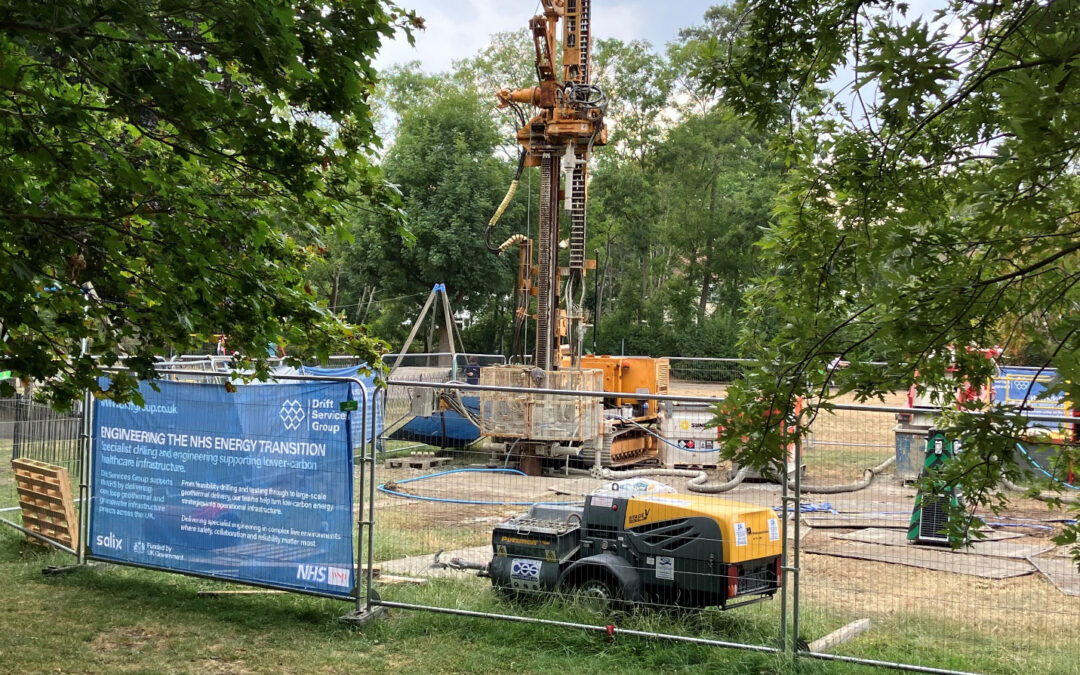
One of the boreholes drilling into the Ladywell Fields aquifer, July 2026 Photo: QWAG
Water from the aquifer beneath Ladywell Fields could soon supply a new heating and cooling system across the River Ravensbourne at Lewisham Hospital.
Here’s QWAG’s snapshot of what we have found so far given a lack of public information about the plan, especially the effects on the Fields and implications for the river and the aquifer.
Who knew?
Given the lack of information, few people visiting Ladywell Fields will have known about the hospital’s plan until after 3 June 2026 when areas were fenced off with barriers behind which rigs rose to drill boreholes to access water held in the chalk aquifer over 100 metres beneath the Fields.
Lewisham and Greenwich NHS Trust (LGT) say its ten weeks of testing will inform its assessment of whether the plan is feasible and cost effective. A planning application may then go to Lewisham Council.
Banners hung from the barriers promoted what LGT says is “a once in a generation” project to replace the hospital’s ageing and energy-hungry boilers with an open-loop ground-source heat pump. www.lewishamandgreenwich.nhs.uk/ground-source-heat-pump-project-at-uhl
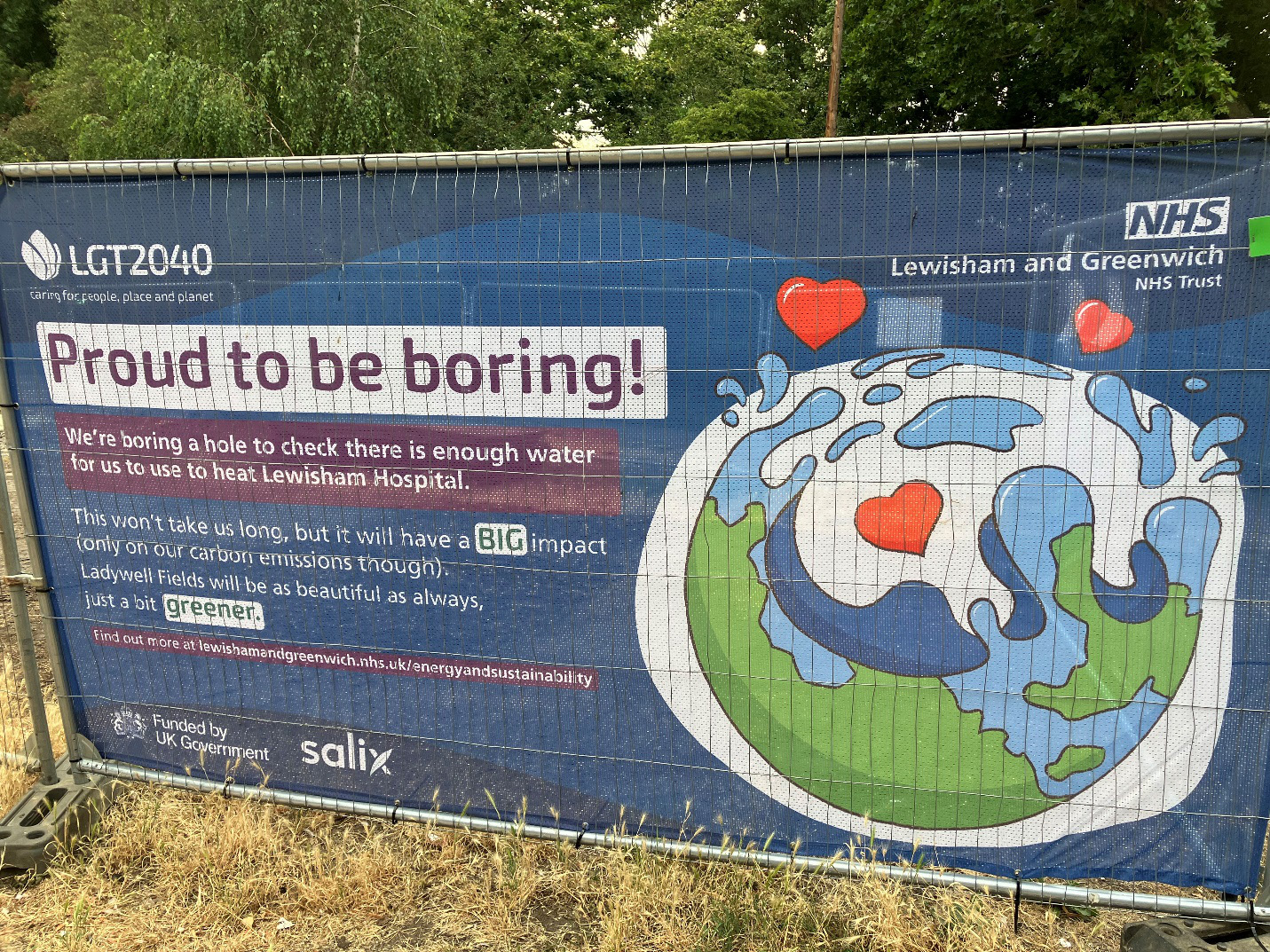
A promotional banner hung from a fenced-off area, July 2026 Photo: QWAG
Open-loop heat pumps take water from rivers, waterbodies or aquifers to heat or cool buildings. Water is returned to the river / aquifer after use. It’s clever but is it the right system? Will it be great if the river, groundwaters and aquifer are harmed?
These questions occurred to QWAG when we suddenly saw the works, and LGT’s claims made about its project. Other questions include:
- How will the Fields, its trees and wildlife be affected?
- Will everything be restored after test drilling, or will things stay in place?
- Why an open-loop ground-source heat pump?
- How do other options – such as air source and closed loop systems – compare?
- Will waters be at risk of contamination by chemicals from the heat pump?
- Which consultants and companies are involved and on what basis?
Looking beyond promotional and standard information QWAG asked LGT some straight questions in pursuit of helpful, open, and straight answers.
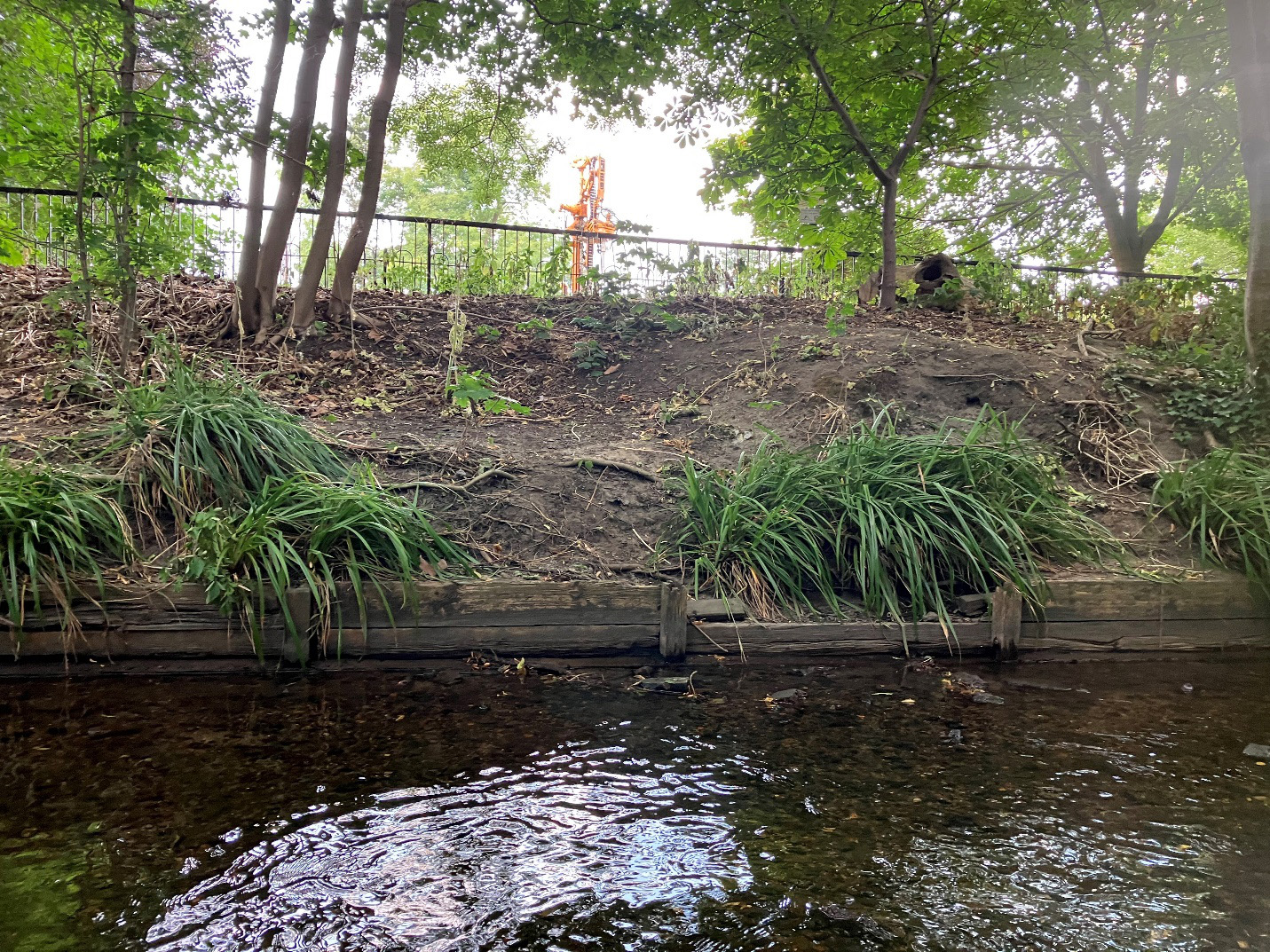
Drilling rig seen from the River Ravensbourne, July 2026 Photo: QWAG
No secrecy
To start with, QWAG asked LGT about the lack of public information until the trial works started:
- Who knew about the project and when?
- Did the Trust ask for anyone to keep quiet about the project?
- Why were QWAG and other interested community groups not contacted?
When QWAG asked on Facebook why there seemed to be “so much secrecy” about the plans, a reply said: “No secrecy at all. Full details on Ladywell Fields Facebook and Friends of Ladywell Fields Instagram.” The posts were mainly general lines from LGT so did not address QWAG’s queries. No ‘secrecy’ perhaps but not “full details” either.
Why QWAG is interested
It helps for QWAG to know because people often ask us about local rivers and watery matters. Our questions might also touch on things people might want to know.
QWAG is free of political, commercial or vested interests. We’re independent and can’t be bought. We say what needs to be said: we say if something is good; ditto if we think the opposite. We give constructive feedback, suggestions and solutions to make bad things good and good things great.
LGT, Lewisham Council and others involved should want to be straight with everyone about the plans. If the heat pump is great with few if any downsides be open about it.
A lack of public information
LGT says its public engagement has prioritised “key park stakeholders” from the landowner, Lewisham Council, to immediate local residents, and the Friends of Ladywell Fields. LGT told QWAG it met the latter in late 2025 and asked the group not to share any information.
Other groups such as QWAG with our interest in rivers were not informed. LGT told QWAG that its public engagement was “proportionate to the stage of design and the likelihood of the project to progress, as the Trust obviously has limited resources.”
QWAG and other groups have fewer resources than the Trust and its consultants, and it would not have taken much to proactively contact QWAG and others likely to want to know about a project that directly affects a local river and groundwaters.
LGT said that “as the project has become more visible” – such as people seeing drilling rigs behind fences – it has issued “wider communications through website information, local notifications, and direct responses” to enquiries it has received. If the project proceeds LGT says it will devise a communications and engagement plan.
We expect open, proactive, two-way contact in clear, accurate, and timely ways, not one-way promotional claims and standardised replies.
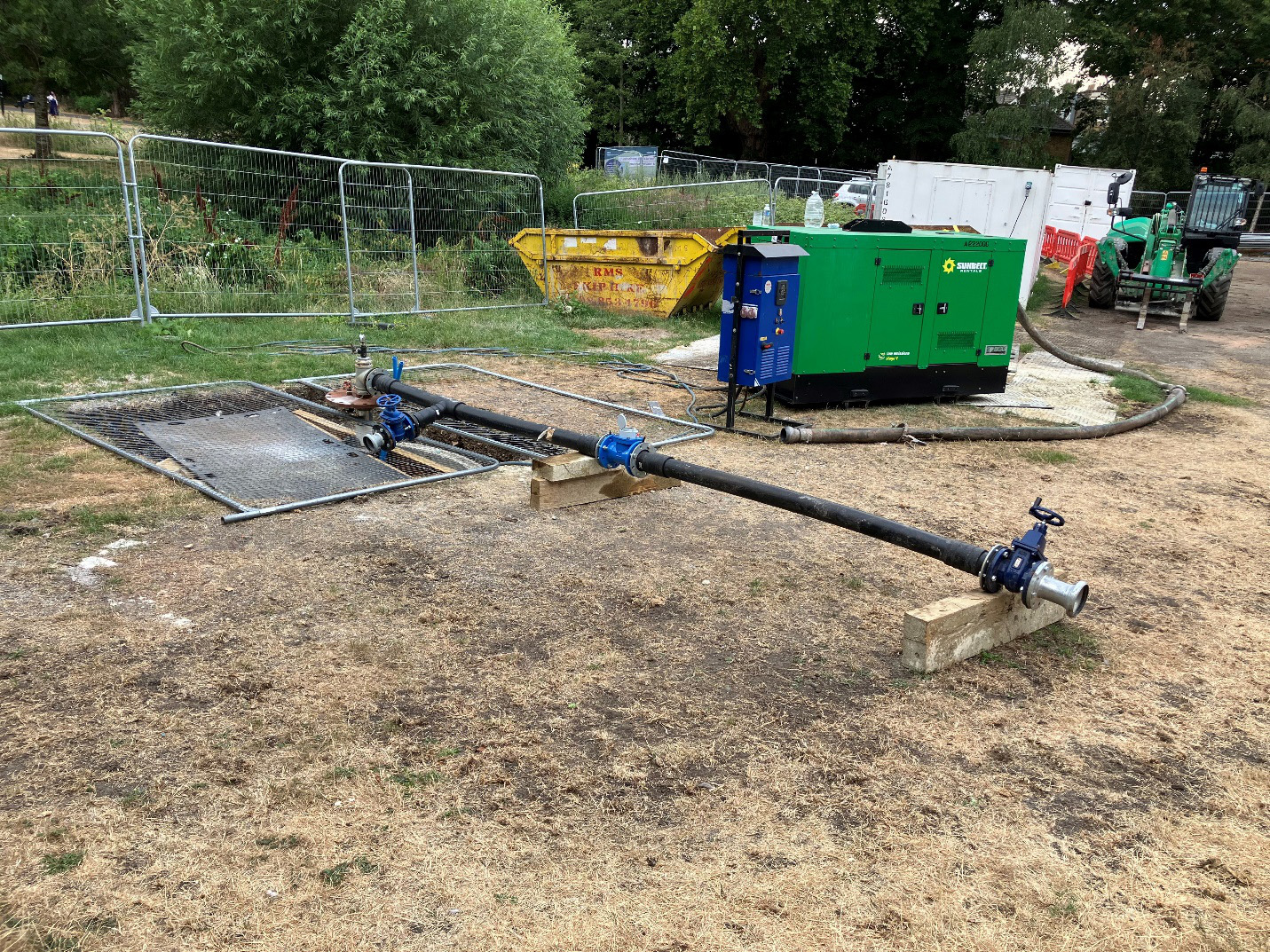
The drilled borehole near Ladywell Bridge, July 2026. Photo: QWAG
Our questions and some answers
As well as questions on why so few people knew, it’s fundamental to know the potential effects on the river, groundwaters and aquifer, and that means knowing more about:
- The origins of the project.
- The advantages of the chosen open-loop heat pump system over other options.
- Who is involved in the project – consultants, contactors, funders etc.
- Why the Trust is using the Fields and not the hospital’s own grounds.
- Whether the 10-week testing across summer 2026 will be enough to test for all of the likely effects that will occur all year round.
As a result of QWAG probing for more useful information since we saw the fences erected, the position on some of the main concerns seems to be as follows.
1. On the use of and effects on the Fields
LGT says the aquifer works for its chosen system open-loop ground source heat pump system adding that the grounds of its hospital are too small to drill the size and number of boreholes needed to reach the aquifer.
LGT says its feasibility studies looked at how to avoid or reduce effects on the Fields, the trees, habitats, and public use, and informed the design, location and operation of the test phase.
The Trust adds that the “test works are localised and reversible” and that all equipment will be removed and the ground and grassed areas repaired if needed.
Repairing the drilled aquifer isn’t ‘reversible’, but if the project goes ahead, the LGT says the test boreholes and pipework would stay but would be below ground with only access hatches being visible.
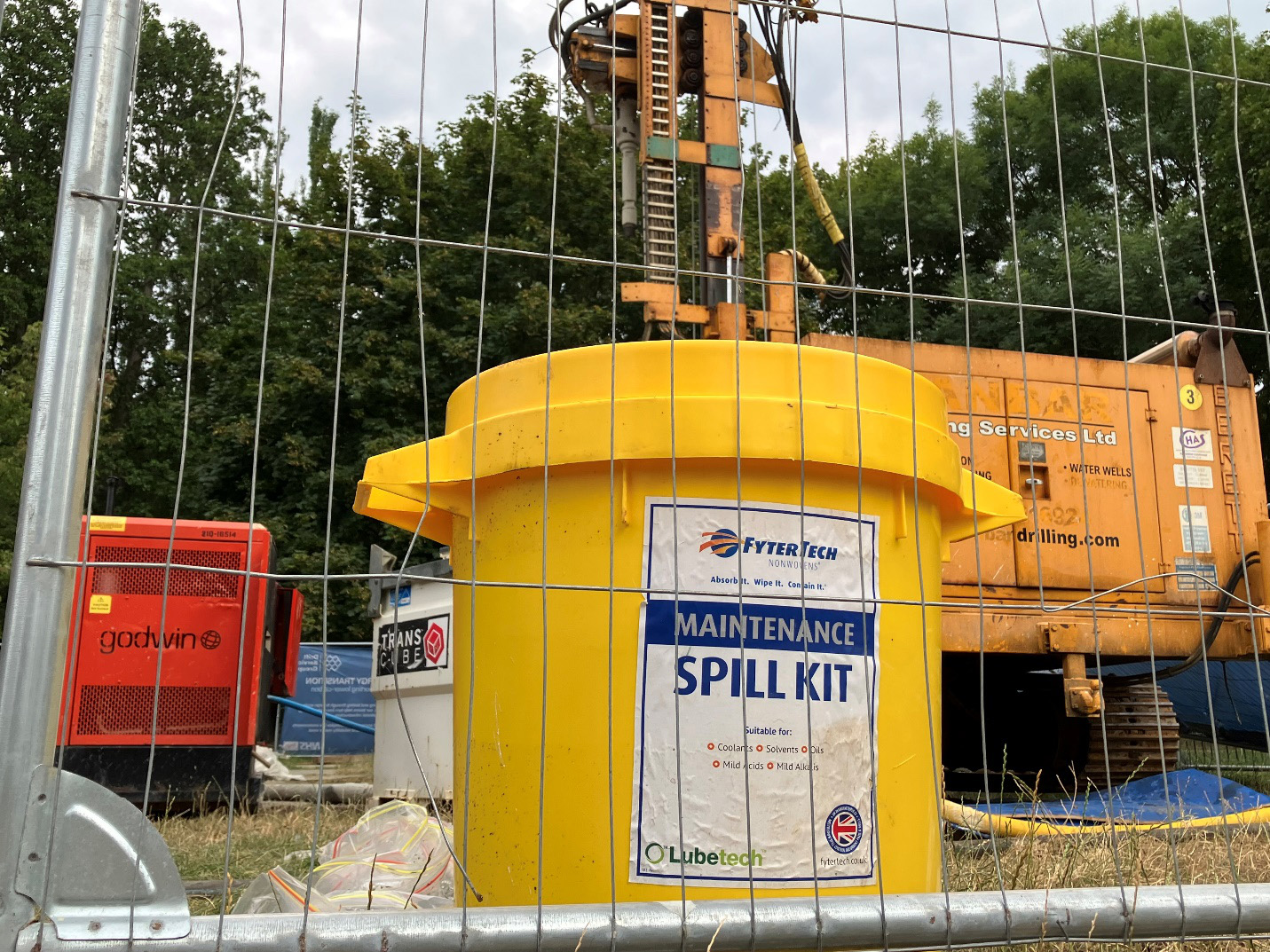
One of the drill rigs in Ladywell Fields, July 2026. Photo: QWAG
2. On the effects on the aquifer and river
LGT says it has assessed that the aquifer is suitable to supply its chosen heating and cooling system, but that the test drilling will check that as well as being assessed by the Environment Agency.
When QWAG asked about the aquifer still needing to function properly LGT agreed that, ultimately, the suitability of its chosen system depends on the integrity of the aquifer being maintained.
Factors include:
- The aquifer being pumped for water all year round.
- The effect of returning water that has been heated to the aquifer and the river.
- The risk of lubricants, solvents and other chemicals used in the heat and cooling system getting into the water.
In mid-July, drilling of the test boreholes halted when chalk sediment from the drilled aquifer got into the river.
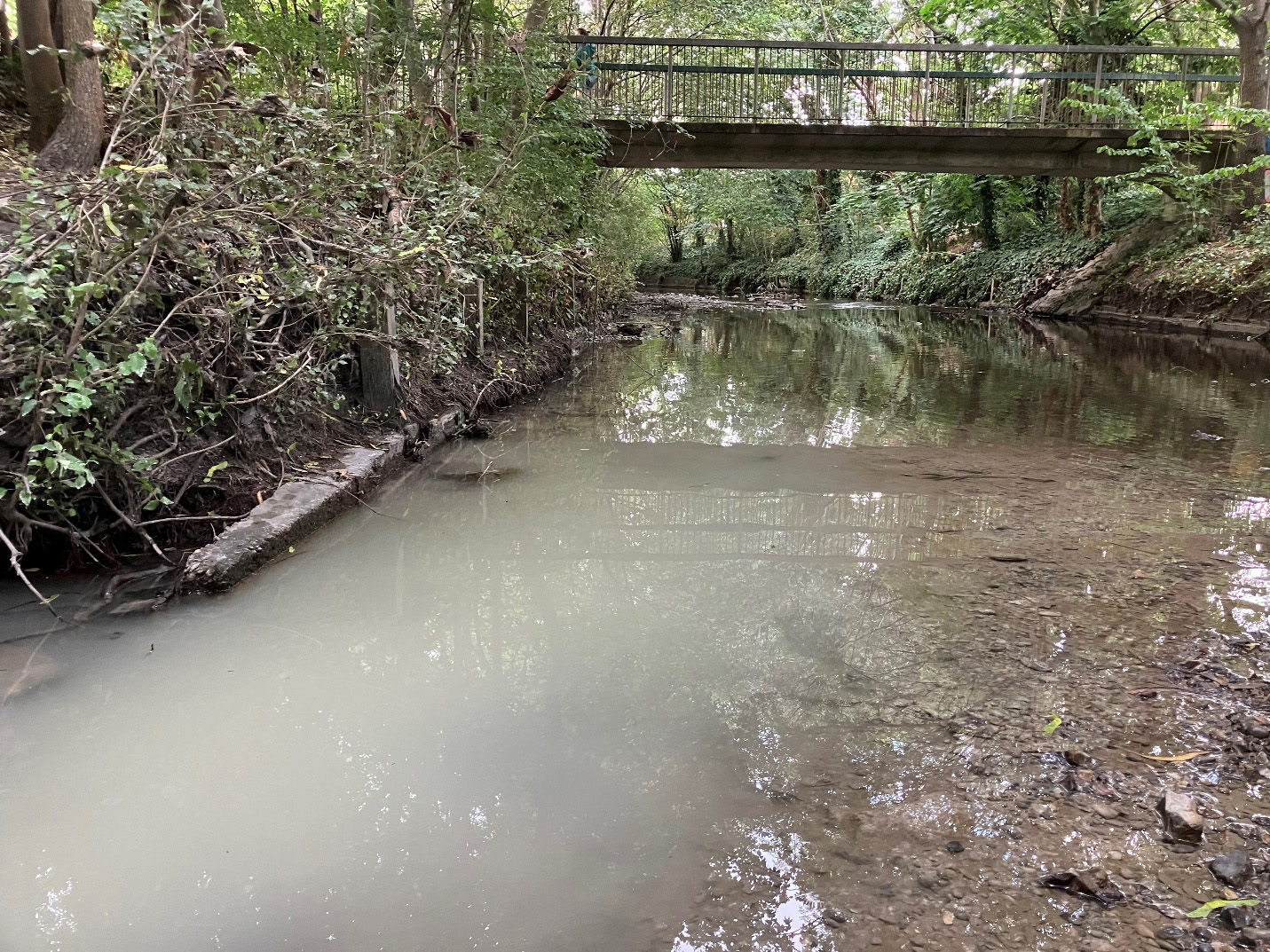
Chalk from the aquifer in the river near Ladywell Bridge, July 2026 Photo: QWAG
3. On the chosen technology
LGT says that its chosen open-loop ground-source heat pump:
- Is more efficient than other systems – how much more efficient isn’t clear.
- Takes up less space and infrastructure than other systems – although an air-source heat pump could be fitted within the hospital’s own grounds.
- Needs fewer boreholes than a closed-loop system – how many fewer is not clear.
- Is being used elsewhere – although the examples LGT cited vary enormously.
- Involves more stable groundwater temperatures – but as mentioned above, it’s not clear how the temperature of the aquifer and groundwaters would be affected.
Next steps?
Lewisham and Greenwich NHS Trust say the plans will only proceed if they are demonstrated to be safe, including from the 10-week summer drilling and testing.
If the results are positive a planning application will go to Lewisham Council which is when LGT will provide more detail and technical information including from the testing although any information deemed to be ‘commercially sensitive’ will be excluded.
As the LGT itself told QWAG, the integrity of the aquifer is paramount, and it will be important to understand the likely effects on it and the river.
For more on that and other questions arising from LGT’s replies to date and the works to come watch this space for updates.
QWAG will continue to probe the plans in general, the effects on the river and aquifer in particular, and will push for LGT and all others involved to be open on all matters.