


“We are thoroughly hacked off by the lack of action and how we have been ignored despite trying to do the right thing in the right way.”
QWAG to Lewisham Council, November 2025
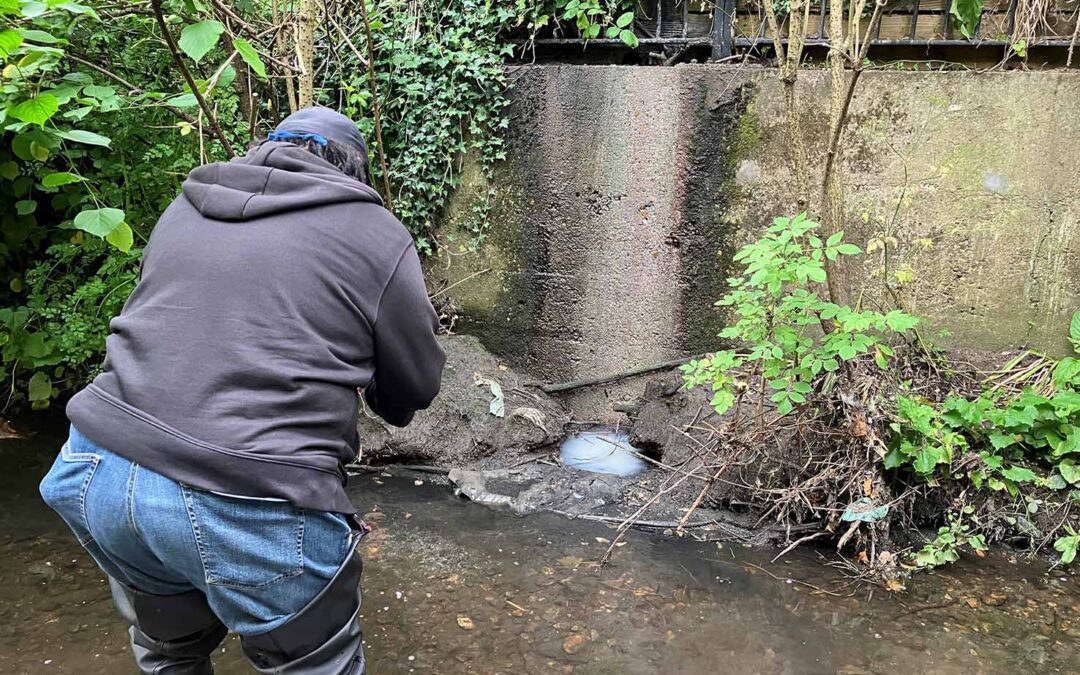
Since summer 2022 QWAG has tried to stop pollution of the River Quaggy from a house in Hither Green, Lewisham.
This single saga exposes a systemic failure by elected politicians, council officers, Thames Water and the government’s weakened Environment Agency.
Years of deliberate pollution of a cherished local river from just one property highlights how:
- Pollution harming our local rivers is effectively downgraded and ignored.
- The government’s better-late-than-never focus on sewage spills means that the other types of pollution that are also harming our rivers are routinely overlooked.
- The way for people to report pollution is complicated, unresponsive, and is not fit for purpose for this area.
The 4-year saga also shows:
- Claims by those in authority to care about the dire state of our rivers are hollow because they are unresponsive, stuck in siloes and unwilling to take responsibility.
- The insights and goodwill of community volunteers and river action groups such as QWAG is taken for granted, and volunteers are patronised as a matter of course.
Eyes and ears
We often spot river pollution and other problems.
We look for what might be harming our rivers and preventing them from moving on from being officially classed as being in poor ecological condition.
We work for lasting solutions not sticking plasters.
We’re just one set of eyes and ears on our local rivers but we’re quite well-known and people report their concerns to us and ask for help.
But if experienced river action groups like us have such a hard time getting even minor sources of pollution taken seriously, what does that mean for members of the public?
Water companies, the government and its weakened Environment Agency say they want people to take time to report pollution. But the pollution reporting system for this area is outmoded, unresponsive, opaque and too often leads to nothing happening.
That is compounded by official and individual incompetence with too many in positions of authority happy to pass the buck instead of taking responsibility to get things done.
Hallmarks of failure
This single saga sees community volunteers spending years – 3-4 years in this case – trying to be heard about an issue that could have been addressed in a matter of weeks.
When public concern continues about the poor state of our rivers and freshwaters, the saga shows that rigid ways of working, buck-passing, washing hands of the issue and giving community groups the silent treatment are the order of the day.
The government, its agencies, councils, and water companies claim they value and want to work productively with community groups and the public. Yet agile, responsive, and co-operative ways of working are nowhere to be seen.
Hallmarks of the saga include:
- Unresponsiveness – a complete failure to respond to repeated requests to act swiftly to prevent pollution from just one property.
- Patronising volunteers – an attitude toward community volunteers including us, an experienced river action group that might know what it is talking about, that contrast with the usual claims that voluntary action is valued.
- Individual and collective failure to meet own standards – with either nil response or automated emails being the only response received followed by months of silence. Promises of responses within 10 working days failing to materialise was often the best we got.
- Buck passing at all levels – from local councillors, officers and the MP to Thames Water and Environment Agency staff – all had to be chased, and chased, and…. It’s not clear that any individuals took responsibility to liaise with others to secure swift resolution.
- We know best attitude / failure to listen – the Council, Environment Agency, Thames Water each wasted our and their time, and missed opportunities to act themselves, often insisting on doing things their own way instead of simply working with us to get things done to avoid the kind of delay seen with this case.
- No overall controlling hand – someone who would ensure internal understanding, direct and oversee action to secure swift resolution, and to ensure well-informed and sensitive contact and communication. For example, someone who would avoid the sending of patronising emails, having our time wasted by being told things we already know, or being asked to report the problem when the system to do that was unfit for purpose.
- Failure to talk – even when we had provided a full dossier on the case, and repeatedly offered to talk and meet, no direct conversations were offered to get the grips with the issues and start resolving the problem.
- Only acting when we went public – In November 2025, after years of being ignored or hearing nothing back, QWAG posted a simple message on social media. We should not have to do that to gain attention every time there is an issue. But it worked. Is that how we now have to communicate to get a proper, respectful responses from anyone in authority?
Pollution timeline – the whole story
During the 4-year saga, Thames Water told us there was “no concern with the health of the river”, and the Environment Agency told us the daily discharge “presented a relatively low risk to the environment. In light of this it is unlikely any further action will be taken…”
In short, don’t worry about it. Below is a snapshot of what happened – and what didn’t.
June 2022:
- QWAG spot pollution of the River Quaggy from the rear of a property, advise the Environment Agency, and post pictures and video on our social media.
November 2022:
- QWAG report the ongoing problem to the meeting of the Ravensbourne Catchment Improvement Group (RCIG) – the partnership of councils, community groups and others with an interest in improving local rivers.
- After the meeting QWAG ask the Environment Agency to “please expedite this by advising what the status of the reports and actions is, or if any extra information is needed to do this (act on the pollution)” so that “we do not need to wait until the next RCIG meeting in February 2023.”
- The Agency replies, “It is possible the incidents were closed without further communication if no action was deemed necessary.” QWAG is told: “please do feel free to continue to report any such issues. I appreciate that receiving no response can be very frustrating…”
- QWAG state that we “increasingly doubt the worth in using them (pollution reporting systems) and of QWAG asking people to report to them when we as a group hear nothing and have to push for engagement.”
The worth of the system for the public to report pollution comes into play later on.
2023 – Passing the buck
February 2023:
- The Environment Agency tell QWAG: “…the pipe discharge into the Quaggy… is still languishing with Lewisham Council. We are aware of an ongoing minor private misconnection in the Manor Park area. We assessed the information about the incident, and it was determined that it presented a relatively low risk to the environment. In light of this it is unlikely any further action will be taken. Like other public bodies, we have to prioritise the deployment of our resources, and we are unable to deal with every incident reported to us. This ensures we are able to respond to the incidents which pose the greatest risk to the environment.”
- This response does not prevent the Agency from getting the local council to act to end the pollution of the Quaggy with waste water from a household.
The significance of this response is that it shows that the kind of routine non-sewage pollution that tends to be seen in this area is systemically overlooked.
Sewage spills make the national news headlines, but in this area / river catchment, they are not the main pollution problem.
The main reason our rivers continue to have poor water quality and are still classed as being in poor overall ecological condition is down to them still being stuck in too much unnatural concrete channels where they also get hit with pollution from roads, land, litter, waste from construction sites, and badly plumbed-in pipes from homes and businesses.
Dodgy plumbing in DIY, refurbishments and even in new builds is rife. But the official line from our underperforming water company, Thames Water, and from the government’s own once world-leading Environment Agency is for everyone to stop worrying about it.
The official line seems to be: Everything’s fine. Yet they still want people to report pollution and other problems using a reporting system that is not up to the job.
That is because most of the routine pollution that undermines our rivers is not considered important enough. Sewage and major incidents such as the large oil spill in 2016 that polluted the same stretch of the River Quaggy as the waste water from this single household are taken seriously. The daily routine pollution we see all of the time is not.
Recap:
By early 2023, then – just eight months into the saga:
– The Environment Agency had been told several times about the issue and had the location and evidence, all to no effect because the Agency said the deliberate pollution wasn’t important enough, and records could not be found.
– The matter had been raised several times at Ravensbourne Catchment Improvement Group meetings, also to no effect, raising questions about the value of that group.
Even allowing for pressures on the Agency due to the ongoing effect of government cuts, the lack of responsiveness to a local river action group which is trying to help – and which the Agency and others expect to co-operate on various matters – was starting to grate.
It is also incredibly naïve if anyone thought this would not start to become an issue and a risk for future positive working – which is exactly what has happened.
If the Agency thought Lewisham Council should resolve the pollution spill, did the Agency pass this on to the Council in a way likely to result in action, and would QWAG ever have a clear line of sight on that?
Now we fast forward to autumn 2023 – because nothing happened for nine months…
October 2023:
- Having seen the pollution yet again QWAG contact the council, a local ward councillor, and the Environment Agency.
- The councillor says they “will share these serious concerns with council officers for them to investigate. If you could send me any photographic supporting evidence, that would be helpful.”
- QWAG supply the footage and photos to date.
2024 – Enter Thames Water – farcically
March 2024:
- QWAG film more pollution and advise the local councillor, and Agency.
- QWAG post the footage on social media prompting Thames Water (TW) to visit.
- QWAG offer to show TW the precise location. TW reject QWAG’s help and insist on visiting late on a Friday night visit.
- TW disturb residents and fail to find the location. Another visit the next morning fails when TW lack wellies / waders – QWAG had offered these.
- After a third visit TW declares “no concern with the health of the river” which is odd since waste water, detergents, microfibres and other substances which should not be entering the river at all are likely to be being doing so several times a day.
- Thames Water say, “As the pipe is private it will be down to the homeowners to resolve this and to remove the pipe or connect it correctly. We’ll be liaising with the customer to make them aware” and that “yes, there will be follow ups with the homeowners.”
- QWAG contact the Council again given that the property is a House of Multiple Occupation (HMO) and is, apparently, already known to
- Lewisham Council as a problem property. QWAG receives no reply.
April 2024:
- A council officer tells QWAG, and also the local councillor and the then Mayor of Lewisham, Cllr Brenda Dacres, that “…the power to take action to resolve the matters raised resides with a number of agencies including the Council i.e., Section 59 of the Building Act 1984. I am unsure at present who within the Council has the delegated power for this legislation and will investigate further in this regard. However, in the meantime please can you provide with all the evidence you have to date to establish the source is sullage (waste water) to avoid any possible delay.”
- QWAG already know the relevant powers and has also provided visual evidence. But we were getting used to being told things as though we were born yesterday.
May 2024:
- Following its farcical site visit in March 2024 Thames Water tell QWAG:
“I’m very sorry you’ve needed to write to us further due to the fact the reason for your initial email dated 16 April wasn’t addressed whatsoever. - Due to this, your email has been escalated to a second stage complaint which is the highest level of complaint within our business, therefore it’s been passed to myself to complete a further review to address any points that have been missed.
- “We work with the Environment Agency (EA), Local Authorities (LA) and the local community, to reduce pollution in the rivers and streams across our region caused by misconnected pipes as we take misconnections very seriously.
- “I can confirm we are aware of misconnected pipes within Manor Park and are working with the residents to investigate further and resolve this matter.
- Later, Thames Water repeats, “we’re aware of misconnections within Manor Park and we’re dealing with them accordingly. It may be helpful to explain, whilst we can identify misconnections, we have no powers of enforcement, as this lies with the Local Authorities (LA) who will then become involved.”
In summary, Thames Water says it is aware of the pollution says it is investigating, but that the power to resolve rests with the local council. Did TW follow up with Lewisham Council to make sure the resolution happened?
Also in May 2024:
- A Council officer with Lewisham’s Anti-Social Behaviour and Statutory Nuisance team contacts QWAG to say they have been “been requested to investigate the alleged spillage into the river Quaggy”.
- The officer requests from QWAG “some details of the source of the alleged spillage” and a time to visit the site so “that we can witness the source of this spillage in the river Quaggy.”
- QWAG offer to show the Council officer the precise location and adds that to aid communication and smooth resolution, QWAG would be “happy to chat with you and your manager and others, either on the telephone, on Zoom / Teams etc, or by meeting in person.”
- The officer advises QWAG that: “I and another colleague (visited the property) to discuss these allegations, that the waste pipe was coming from (the property). The gentleman inside was not very helpful and refused to give his name, which made it difficult to progress our investigation. We need to witness where the pipe is coming from, for our own investigation… to witness where the wastewater is actually coming from, and which wall the pipe is positioned on. I’m afraid we cannot give you a quick fix for this problem as we would not make unproven allegations.”
QWAG was not making ‘unproven allegations’, but we did except reasonably swift resolution given how much time had passed by now – almost two years. Our expectation of anything approaching a ‘quick fix’ was long gone.
June 2024:
- QWAG take the Council worker to see the site of the pollution for themselves.
- The Council now has its own filmed and photographic evidence – in addition to being able to see the videos and photos QWAG posted since June 2022.
September 2024:
- The Council worker emails QWAG to say “Thank you for your patience on this matter. As you say, it has been long enough for some action to have been taken. I have escalated this to my manager who is investigating as a supposed breach regarding building control had happened at the address… but no follow up has happened. I will speak to my manager again and the manager at Building Control.”
November 2024:
- QWAG emails the Council worker to ask about progress and to suggest “that you are being let down by your Colleagues in Building Control…we give it a few more weeks but no longer to get resolution otherwise it needs escalation and public awareness that a Council that purports to care about the Environment and exhorts us to take measures towards tackling pollution and climate change is incapable of doing it themselves?… please contact your Manager and Building Control to give me a speedy update on exactly where this has got or not got to.”
- The Council officer replies that “I have contacted Building Control and the officer who was assigned to work with me for an update on their progress with contacting the owner of the basement property.”
2025 – Back to Square One
January 2025:
- The Council officer emails QWAG to say “Due to a lack of response from Building Control, I will have to start this process again. With a heavy workload, I was hoping to pass this case on to my colleagues in building control.
- “… building control (need) to make entry into the property, so an inspection of their plumbing can be undertaken. I cannot say if the officer dealing with the case before is still working for Lewisham, but I will contact the team today.
- “It may help speed things along if you contact building control and ask them to investigate the property.”
February 2025:
- QWAG do as the Council officer asks and contact Lewisham’s Building Control (copying in – yet again – the then Mayor of Lewisham, Brenda Dacres, the local ward councillor and senior Council Cabinet Members for Housing and for Environment).
- QWAG ask Building Control: “if you could confirm receipt of this message, a reminder of which will be sent if receipt is not acknowledged within the next two weeks, and a sense of how you will proceed and the timescale. Do contact me if anything is unclear about this request. Otherwise, we look forward to rapid resolution of this matter before the third anniversary of us first seeking resolution.”
- Building Control do not reply – at all. Neither do the Councillors.
- Later, the Council officer from the Anti-social behaviour / Statutory nuisance team contacts QWAG with a formal reference (Pollution of River Quaggy, WK/202407613’). They state: “As we have evidence of past spillages into the Quaggy from my inspection… the main barrier to progressing with any enforcement has been the need to inspect the works done at (the property).
- “Building Control has agreed to a joined-up approach, so once we gain access, they can take the lead on the works that are needed to rectify this problem.
- “I will also be speaking to our licensing, Private Sector Enforcement team, to see if they can bring any weight to bear on the homeowner at this address as he runs a House of Multiple Occupation (HMO), they may have powers to deal with shoddy workmanship that is polluting this local waterway.”
April 2025:
- The Council officer asks QWAG for more visual evidence of pollution. This is despite the officer and the Council, already having photos and videos as well as being able to view QWAG’s social media to check that we were not making things up.
June 2025:
- QWAG chase for updates since April 2025.
October 2025:
- QWAG emails on 13 October to update all involved (Building Control, Mayor, Environment and Housing lead Councillors, the local ward Councillor and local MP) to request urgent resolution, once and for all.
- This followed QWAG witnessing pollution on 12 October. QWAG provided this latest video evidence on top of what had been sent before, and the images the Council work has taken themselves in June 2024. QWAG also sent a full dossier of the saga with dates, names, actions / inactions, delays, excuses and more.
- QWAG requested clear responses on the following six points:
- What action(s) will now be taken by Lewisham Council i.e. the actual steps and processes that will now be pursued, and the timescale for each step and process?
- Who will lead this action i.e. who will be directly responsible for leading the resolution of this prolonged pollution matter. For example, Head of Building Control? Someone else?
- Who else will be involved – i.e. which other parties will be involved and how will their involvement be checked to ensure their participation does not lead to further inaction, delay or other reasons for this pollution of the River Quaggy continuing for the rest of 2025?
- How the Mayor of Lewisham, relevant Cabinet Members and Ward Councillors will now keep this matter to the forefront?
- How QWAG will be kept fully up to date each day or week to avoid QWAG having to chase as we have done for over three years as shown in the dossier?
- As usual, QWAG also offered to speak, meet or chat over Zoom/Teams if anything is unclear and if doing so would aid understanding and expedite resolution.
November 2025:
- QWAG received no substantive reply to its 13 October request. QWAG had sought a swift “formal response this week that fully addresses the following five points…”.
- Instead, two standard acknowledgments were received, firstly from Lewisham Building Control, and then from the Mayor of Lewisham’s office, as follows:
- On Monday 13 October at 11.22am Lewisham Council’s Building Control replied: “Thank you for contacting Lewisham Building Control. We can confirm receipt of your email, and that we will respond to you at the earliest opportunity….”
- On Tuesday 14 October at 2.10pm, the Mayor of Lewisham’s Casework Team acknowledged QWAG’s communication: “Thank you for your e-mail to the Mayor’s Office, dated 13th October 2025. Please accept this as an acknowledgement of your e-mail. Your e-mail has been logged with the relevant service, and they will aim to respond to your enquiry within 10 working days (Monday to Friday, excluding bank holidays, between 9am and 5pm). If you need to contact the Council regarding this enquiry in the future, please quote reference number: 33350933.”
According to the Mayor of Lewisham’s office:
- 10 working days from Monday 13 October, when Lewisham Building Control sent its standard acknowledgement, would have been Monday 27 October (between 9am and 5pm).
- 10 working days from Tuesday 14 October, when the Mayor of Lewisham’s office sent its reply to say that “the relevant service” (Building Control?) would “aim” to reply, would have been Tuesday 28 October (between 9am and 5pm)
By Thursday 13 November, QWAG had still not received a substantive reply a full month and 23 working days since it notified the Council on Monday 13 October.
QWAG reluctantly decided to post the following on its social media:
Lewisham Council claims to care about our local rivers.
Why is it failing to:
– Prevent the #RiverQuaggy being polluted by just one property for over 3 years?
– Respond promptly to us and the dossier we sent to the Mayor and lead Councillors?
– Being mute and inactive over one polluting property doesn’t bode well for other pollution of our local rivers.
– We’ve sent comprehensive information and offered to talk / meet – but just get the silent treatment.
– We first reported this pollution in June 2022 – will we still have to deal with this pollution in 2026?
– And is this how Lewisham now behaves toward local community voluntary groups like QWAG?
For the first time, a senior Councillor replies.
2026 – pollution continues
The saga continued into a fourth calendar year.
It took until later January 2026 for Lewisham Council to stop the pollution from the property – something that should have happened at any point since June 2022 when QWAG first asked for the pollution to be stopped.
This single saga highlights systemic failures that require a complete reset in how the council, its elected representatives and officers, and the Environment Agency and Thames Water work together and with community groups like QWAG.
If there’s a silver lining…
If there is a way forward, it would be to secure a credible pollution reporting system for the area.
The current system is overly geared to sewage spills when those are rare and are not the main reason for our local rivers and freshwaters being stuck in a cycle of poor water quality and failing ecological condition.
The area needs a tailored pollution monitoring system – one that works for the area because the public can trust it and won’t have to wait for action and resolution as we have since 2022.
Local MPs, councillors and the Environment Agency should now get behind that.
Will they now work with QWAG to secure that, and help improve our local rivers by unleashing them from concrete, and or will we have to wait, and wait, and wait…?
PS: Official Apology
On 6 February 2026 QWAG received a formal apology from Lewisham Council – albeit from a senior officer, not from the Leader of the Council – for:
– not handling the 3-4 year repeat requests to help end pollution of the River Quaggy “to the standard that residents and community partners are entitled to expect…”
– “unacceptable delays in responding to your correspondence…”
– “shortcomings in our internal coordination between services…”
– “a lack of clear ownership, timescales and proactive communication…”
The letter stated, “These failures contributed to a loss of confidence and caused understandable frustration” and promised a new approach to dealing with us (and others) when issues arise.
The issue is whether things really do improve. We know local councils are still struggling under cost pressures. The answer to that is not to ignore us and other community groups while patronising us.
That also does not match the claims made by Councillors – not least when they are out and about doing litter picks as part of their local election campaigns and to take photos for their social media and leaflets.
This 3-4 year pollution saga contrasts with claims by election candidates that listening, working for residents, and getting things done are what local representation should be about.