


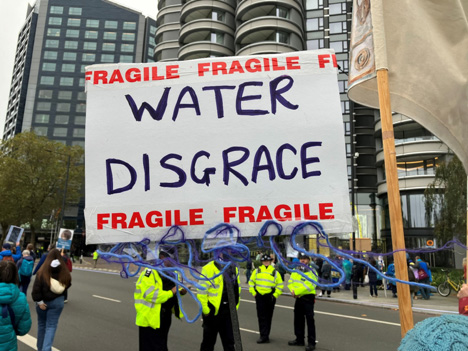
‘Water Disgrace’ banner on the March for Water 4 November 2024 Photo: QWAG
Mayor of London, Sir Sadiq Khan, launched his Clean Rivers and Waterways Plan on 29 July 2026. The Mayor’s welcome dive into our rivers is a big change from a few years ago when he was unambitious for our rivers – see below – to say the least.
Will the Mayor’s new Plan and the millions pledged do what’s most needed to properly restore our rivers currently choked in concrete? And what is the role of the truly local river action groups who were not part of the Plan?
A bigger splash
Launching a 10-Year Plan for London’s rivers and waterways to be clean, healthy and even ‘swimmable’, Mayor Khan said:
“This plan marks the beginning of one of the world’s most ambitious urban waterway clean-up efforts. It sets out what we need to do to reduce pollution, revive nature and restore public access to our waterways to make every one of them clean, healthy and thriving.”
You can read the Plan here.
The Mayor has no direct control over rivers so his convening role in getting others to commit and raise their game is important.
Splashing the cash
That and putting some money behind the pledges.
The Plan is backed by a decent injection of cash over time although it’s not clear that the funds will be devoted to the most important river restorations that would make the most difference.
The Plan was launched with the announcement of further funding – more than was announced when the Mayor’s initial plan was launched in 2025 (see below):
“To help kick start the 10-year plan, which is backed by £1.8 billion from partners over five years, the Mayor has pledged an additional £2.7million to support new blue and green restoration projects in the city over the next three years. This boosts the existing £13.55m he has already pledged to transform the capital’s waterways.”
The Plan has earmarked money for action in ten of London’s river catchments including the Ravensbourne Catchment which includes the Quaggy, Pool and Ravensbourne rivers, their tributaries and other water bodies.
How much will come to the Ravensbourne catchment is unknown, but any sums need to be devoted to genuine river restoration meaning the physical removal of rivers from concrete.
The Mayor’s change of heart
The Mayor’s 2026 Plan is a much bigger splash than his lack of ambition in 2018 when he launched his London Environment Strategy (LES).
The Strategy rightly referred – on pages 15 and 184 – to the poor ecological condition of most of London’s rivers and water habitats.
At the time only one of London’s 47 river water bodies was officially classed as being in ‘good’ ecological state. Three were ‘bad’, five were ‘poor’ and the rest were ‘moderate’.
Little has changed since then. Poor ecological status is due to a combination of factors and pressures on our rivers including too many stretches being in heavily engineered state – stuck in straight concrete channels – as has been the case with the River Quaggy and other local rivers for decades.
But the Mayor’s Environment Strategy was decidedly downbeat. Page 185 stated that river restoration will occur at “a less rapid rate of implementation than has occurred to date”, and that this “takes into account that opportunities for restoration will get harder compared to earlier years”.
It’s an odd analysis, but it’s certainly the case that we’re still dealing with our rivers being in poor state because successive governments have presided over almost two decades of funding cuts and deregulation along with a general lack of interest from politicians of all persuasions.
That was until the ‘sewage scandal’ hit the headlines. Now our leaders love to talk about rivers.
2024 – Election pledges
Perhaps spurred on by public concern at the state of our rivers and the sewage scandal in particular, Mayor Khan’s 2024 election manifesto said he would turn “London into a wildlife haven”.
He said that he would now apply the same kind of sustained commitment to reversing the poor state of the capital’s rivers and waterbodies as he has in tackling London’s decades of chronic and killer bad air.
In the ‘Making London Greener’ section of his manifesto Mayor Khan said:
“I will launch an ambitious plan to make rivers in London swimmable within ten years. This will include working with partners to reverse the damage done to our rivers and waterways. We’ve made huge progress in cleaning up London’s air – exceeding expectations. Now it’s time to clean up our waterways too.” Building a fairer, safer, greener London for all.
Arguably, the time to clean up our rivers was years ago…
Having been re-elected, in September 2024, Mayor Khan added that:
“As Mayor, I want to turbo-charge the restoration of nature to London’s rivers and waterways…” Mayor of London announces bold plans to revive nature and wildlife in London’s waterways’ | London City Hall
2025 – A plan for clean and healthy rivers
Into 2025 and the Mayor announced a ‘nature-first approach’ to improve water quality and increase biodiversity which, he said, are key to the Clean and Healthy Waterways Plan he was developing as part of his programme on Delivering a Greener and More Climate-Resilient London.
Helpfully, the delivery plan for that programme seeks to disentangle the funding Gordion Knot that makes bidding to do even the simplest positive things to help our rivers is like swimming the English Channel.
The delivery plan stated (para 1.4, page 5) that:
“Unlike the competitive application… the GLA will use its role as London’s strategic authority to target interventions using its key policy frameworks (for example the Clean and Healthy Waterways Plan, the London Surface Water Strategy and the London Green Infrastructure Framework), providing direct funding and convening delivery partners to achieve progress on a small number of long-term, strategic projects.”
As well as cutting through the funding maze, the Mayor said he wanted to:
“deliver a coordinated, 10-year plan for improving London’s waterways, setting clear priorities for reducing pollution, restoring biodiversity, and increasing public access. It will also strengthen collaboration between government, regulators, businesses, and community organisations to drive targeted action on water quality and environmental protection.” In 60 Seconds Sadiq Khan Explains Why It’s Important To Clean London’s Rivers
Swimmable Rivers?
Mayor Khan made several other announcements on healthy rivers including to make them ‘swimmable’.
‘Swimmable rivers’ is an eye-catching political pledge, but it’s not possible in all London rivers. But we get the point.
When they scrutinised the ‘swimmable rivers’ pledge, members of the London Assembly’s Environment Committee said the idea of ‘swimmable rivers’ needs more precision about which water bodies are included, and what is meant by ‘swimmable’ in terms of water quality and access for activities.
The Committee’s report can be seen here: Swimmable Rivers | London City Hall, Towards clean and healthy waterways in London, September 2025, and Making a clean splash – ensuring London’s waters are ‘swimmable’ | London City Hall
Deputy Mayor for Environment and Energy Mete Coban MBE told the Committee that all rivers and waterways in London were in the scope of the Mayor’s Plan:
“The aspiration is to clean all of our water sites across London and all of our rivers in the next ten years.”
Great to hear but as we’ve had decades of aspiration from politicians who then preside over the state of our rivers getting worse, not better, we’ll hold our breath.
Notably, in March 2025, the Mayor also launched a £7.15 million five-year fund to improve river health – £6.65 million from the GLA and £500,000 from Transport for London.
TfL money is good to see because a main reason for the poor state of our rivers is the cocktail of pollutants that comes off local and TfL-owned roads. – Mayor brings together landmark coalition to deliver major new improvements to London’s rivers | London City Hall
Mayor sidelines local river action groups
In welcoming the Mayor’s Plan we note that while he and his team worked with 50 or so mostly larger organisations to devise the Plan, few if any of London’s truly local grassroots river action groups – like QWAG – were involved in any way.
That’s why the list of organisations acknowledged on pages 10-11 of the Plan does not show QWAG and other local voluntary river action groups. We were not invited to any of the discussions despite the Plan taking most of 2025 and 2026 to finalise. We did not even know the final Plan was being launched on 29 July.
Local river actions groups are the eyes and ears on the ground, arguably do much of the work, and are truly connected to the issues and communities. They do this without paid staff, offices and usually with no or modest funding.
We and other river action groups do work with the larger organisations but they do not speak for or somehow represent us and others. TO assume that they do is wrong.
Sink or swim?
Having taken the plunge, the test now is whether our priorities will benefit from the Mayor’s big splash into our rivers.
The Plan contains lots of good aims and pledges and sustained commitment matters – and that has to be better than the false starts we’ve had from central government for almost two decades including promises to really boost sustained action at river catchment level.
Instead, successive governments and ministers have cut funding for local river action to a trickle and have allowed the state of our rivers to worsen, not improve, before our very eyes.
How the Mayor’s money is used and whether is really reaches the grassroots groups is, therefore, a key test.
Swimming in the right direction
Most of the money should go directly to physically restoring our rivers first and foremost. Proper restoration of our heavily engineered and abused rivers must come first.
Money to test water quality is fine and has its place, but it would be better if the government simply funded its watchdog, the Environment Agency, to that properly.
We also already know how bad our rivers are and more testing isn’t going to make as much a difference as the big ticket items of removing rivers from concrete, giving them space to meander / ‘wriggle’ and letting them function as the healthy rivers the Mayor says he wants.
Put another way, do the right thing by rivers and they’ll do much of the rest. Keep them in concrete and we just stay on the hamster wheel.
If the Mayor backs the actions that will make THE biggest difference to our rivers being healthier, we’ll gladly join him for dip in a ‘swimmable’ river of his choice.